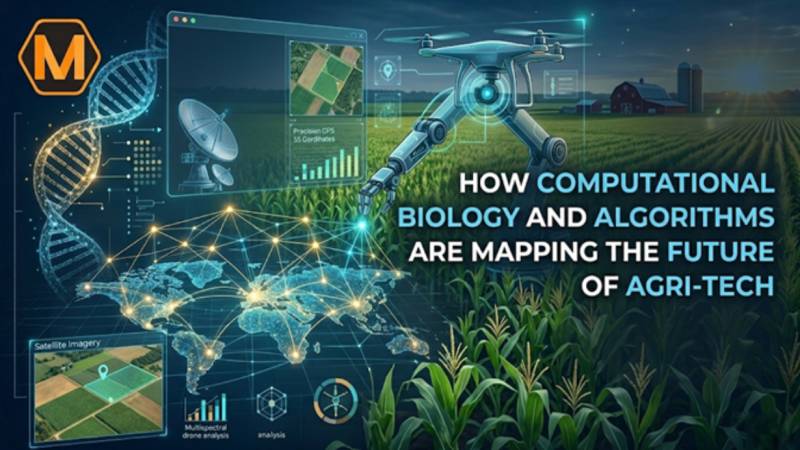
The intersection of agriculture and technology is undergoing a massive paradigm shift. Traditional farming, which once relied almost entirely on seasonal intuition and manual labor, has entered the era of big data. Today, fields of corn, wheat, and specialized crops are treated as complex biological systems that can be modeled, simulated, and optimized. At the heart of this transformation is computational biology—a discipline that uses mathematical modeling, data structures, and advanced algorithms to understand massive biological datasets. For students entering the fields of STEM, agronomy, or environmental science, understanding this transition is no longer optional; it is the blueprint for the future of global food security.
As modern agricultural practices face the compounding pressures of climate change, soil degradation, and a rapidly growing global population, the reliance on raw human labor is no longer sufficient. Instead, the industry demands digital solutions. By processing genomic data, predicting weather patterns, and analyzing soil microbiomes, computational tools allow scientists to make precise interventions. This article explores how algorithmic thinking is being applied to natural ecosystems, turning biological challenges into solvable computational problems.
The Cross-Disciplinary Burden on Modern STEM Students
For undergraduate students pursuing degrees in agricultural sciences or biotechnology, the academic landscape has shifted dramatically. A student studying crop pathology is no longer just working with petri dishes and microscopes; they are increasingly required to write scripts in Python or R to sequence fungal genomes. This sudden intersection of natural science and computer science creates a steep learning curve, often leading overwhelmed students to look for experts who can do my coding homework when deadlines overlap. When the demands of writing dense biological reports and debugging complex data pipelines become too heavy, turning to trusted academic resources by MyAssignmentHelp can streamline a student’s research workflow. Utilizing a structured, modular approach to study ensures that data analysis models are built correctly without sacrificing the depth of the botanical research.
1. Algorithmic Optimization of Crop Genetics
One of the most profound applications of computational biology in agriculture is in the realm of genomics. Traditional crop breeding takes years, sometimes decades, as scientists cross-pollinate plants and wait for successive generations to mature to see if desirable traits—such as drought resistance or higher yield—manifest.
[Traditional Breeding: Parent Crops] —> [Generations of Crossing (Years)] —> [Observed Traits]
|
[Algorithmic Breeding: Genomic Data] —> [Predictive ML Classifiers (Minutes)] ——–+
With modern algorithms, this process is condensed into days. Machine learning models use genomic selection to predict how a plant will perform based on its DNA profile. By training classifiers on historical phenotype data, algorithms can scan the genomes of thousands of seed candidates and instantly flag the ones with the highest statistical probability of thriving in specific environments.
This approach is critical for engineering climate-resilient crops. For instance, predictive algorithms can identify complex, multi-gene interactions that govern how a plant regulates water loss through its stomata. By pinpointing these genetic pathways, researchers can precisely edit crops using CRISPR technology, saving years of trial-and-error field testing.
2. Modeling Fungal Ecosystems and Plant Pathology
Agriculture is a constant battle against pathogens, fungi, and pests. Computational biology allows scientists to study these threats at a molecular level. Consider the complex relationship between host plants and specialized fungi, such as Ustilago maydis (the fungus responsible for corn smut, known culinarily as huitlacoche). While some regions view fungal infections as crop damage, others manage them as high-value culinary assets.
Managing or mitigating these outbreaks requires highly sophisticated predictive modeling. Algorithms process environmental variables—such as ambient humidity, leaf wetness, temperature gradients, and spore density—to predict precisely when and where an infection will spread.
| Algorithmic Vector | Input Data Sources | Agricultural Output |
| Predictive Epidemiology | Satellite imagery, hyper-local weather sensors, humidity logs | Early-warning alerts for localized crop disease outbreaks. |
| Genomic Sequencing | High-throughput sequencing of fungal spores and plant tissue | Identification of mutation vectors in crop pathogens. |
| Metabolic Network Mapping | Chemical analysis of soil nutrients and root exudates | Optimization of organic interventions and bio-fertilizers. |
By analyzing these variables through computational matrices, farmers can apply targeted interventions rather than spraying entire fields with broad-spectrum fungicides. This saves money, reduces environmental chemical runoff, and preserves local biodiversity.
3. Computer Vision and Precision Agronomy
Beyond the microscopic scale of genomics, algorithms are altering macro-level field management through computer vision. Drones and autonomous tractors equipped with multispectral cameras fly over vast agricultural landscapes, capturing images that contain far more data than the human eye can perceive.
Computer vision algorithms break these images down pixel by pixel, calculating specialized metrics like the Normalized Difference Vegetation Index (NDVI). These algorithms can detect subtle shifts in the color and reflectance of crop leaves, signaling nutrient deficiencies, water stress, or pest infestations days before they become visible to a human scout.
[Drone Capture: Multispectral Images] —> [Convolutional Neural Networks (CNN)] —> [NDVI Analysis Map]
|
[Targeted Field Intervention] <——— [GPS Co-ordinates Extracted] <———————-+
Advanced neural networks are trained to recognize the distinct shapes of invasive weed species amidst rows of commercial crops. Automated spraying systems use this real-time algorithmic classification to deploy precise micro-doses of herbicide directly onto the weed, completely bypassing the surrounding soil and crops. This selective application can reduce chemical herbicide usage by up to 90%.
4. Metabolic Network Analysis and Soil Health
A plant does not grow in isolation; it relies on a complex web of interactions within the soil microbiome. Thousands of species of bacteria and fungi live around plant roots, exchanging nutrients, fixing nitrogen, and shielding the plant from disease.
Computational biologists use metabolic network reconstruction to map out these invisible interactions. By sequencing the total DNA found in a handful of soil (metagenomics), algorithms can catalog every microbe present and predict the chemical pathways they utilize.
This data allows agronomists to engineer specialized bio-fertilizers. Instead of dumping synthetic nitrogen onto a field—which degrades soil quality over time and leaks into water tables—scientists can introduce specific microbial cocktails designed to unlock nutrients already bound within the soil architecture. Algorithms model how these introduced microbes will interact with the native population, ensuring the bio-fertilizer stabilizes the ecosystem rather than disrupting it.
Bridging Data Streams: The Multi-Omics Approach
The ultimate goal of computational biology in agri-tech is “multi-omics” integration. This refers to the practice of combining entirely different data streams—genomics (DNA), transcriptomics (RNA expression), proteomics (protein structures), and metabolomics (chemical outputs)—into a single, unified algorithmic framework.
[Genomics: DNA Blueprint]
│
[Transcriptomics: RNA Expression]
│
[Proteomics: Protein Activity]
│
[Metabolomes: Chemical Output]
│
▼
[Integrated Machine Learning / Data Synthesis Model]
│
▼
[Optimal Crop Yield & Disease Prediction]
When these diverse data layers are synthesized, predictive engines can simulate an entire farm’s ecosystem under hypothetical future scenarios. For example, a data synthesis model can simulate how a newly engineered strain of wheat will interact with a degraded soil microbiome during a protracted three-month drought in a specific geographic region. This predictive power allows global agricultural organizations to future-proof supply chains before seeds are ever planted in the ground.
Conclusion: The New Frontier of Agricultural Science
The evolution of agri-tech demonstrates that the future of food production is as much a digital challenge as it is an ecological one. Computational biology, machine learning, and advanced algorithms are pulling agriculture out of empirical trial-and-error and pushing it into the realm of predictable, programmable science.
For undergraduate students navigating this interdisciplinary shift, the challenge is significant, but the rewards are profound. By mastering both biological concepts and computational frameworks, the next generation of scientists will possess the tools required to build sustainable, high-yield food systems capable of withstand extreme global environmental shifts. The field is no longer just about planting seeds; it is about writing the code that keeps the world fed.
Frequently Asked Questions (FAQ)
Q.1 What is the primary role of computational biology in agriculture?
Ans: Computational biology uses mathematical models, statistical analysis, and computer algorithms to process vast amounts of biological data. In agriculture, it is primarily used for crop genomic selection, predicting plant disease outbreaks, analyzing soil microbiomes, and optimizing resource management.
Q.2 Why do biology and agronomy students need to learn programming?
Ans: Modern agricultural data—such as genomic sequences, satellite imagery, and soil chemical analyses—is too massive to handle manually. Students need programming skills (typically in Python or R) to build data analysis pipelines, run simulations, and clean large datasets.
Q.3 How do algorithms help reduce chemical usage on farms?
Ans: Algorithms drive precision agriculture. By processing data from drone imagery or IoT sensors, computer vision algorithms can identify exact areas experiencing weed growth or nutrient deficiency. This allows automated machinery to apply chemicals directly to affected plants, minimizing blanket chemical application.
Q.4 What is genomic selection in crop breeding?
Ans: Genomic selection is an algorithmic process where machine learning models analyze the DNA markers of a plant seed to predict its future traits (like yield or drought tolerance). This allows scientists to select the best breeding candidates instantly, bypassing years of physical growth trials.
Q.5 How does climate change affect agri-tech development?
Ans: Climate change accelerates the need for algorithmic agriculture. Because weather patterns are becoming more erratic and extreme, predictive modeling and rapid genetic adaptation tools are required to engineer and manage crops that can survive unpredictable environments.
About The Author
Hi, I’m Mark Hales. As a senior academic consultant and content strategist with MyAssignment Services, I specialize in bridging the gap between complex technical disciplines and impactful communication. See more: huitlacoche.net.